
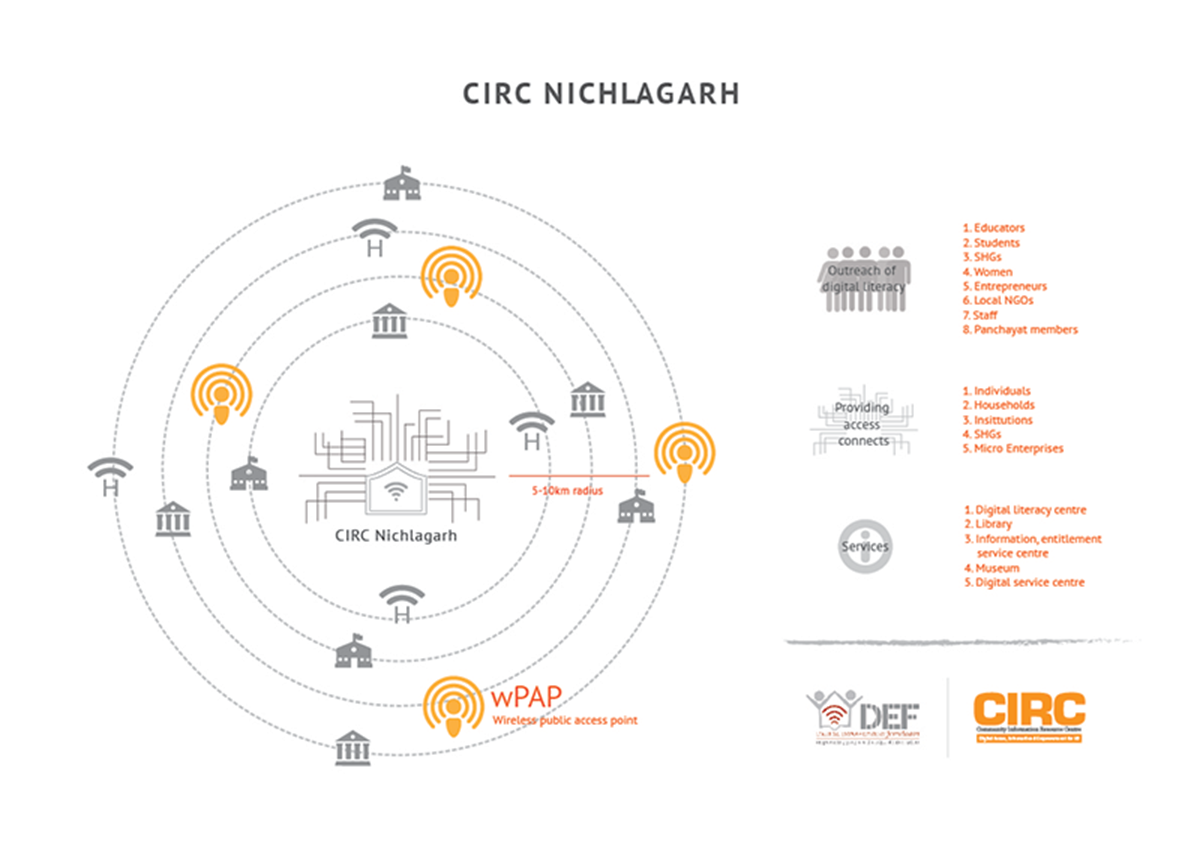
Cluster of Community Information Resource Centres (CIRCs): Each cluster to have one ‘main centre’, supported by village level Community Service Providers (CSPs), and having a catchment of a minimum of 500 Households. The locations of the main centres to be decided by the Federation in consultation with the villagers.
- Main centre: The operations of the Main centre to be led by an Entrepreneur, selected by the SHG members of the village.
- Each of the main centre will be equipped with about 6 laptops, printer, scanner, LCD projectors and screen, and the necessary equipment for power backups. The fixed assets will be provided by the Federation and the entrepreneur would be taking the opportunity cost risk and would run the center as his/her business.
- Training, capacity building, handholding and mentoring support will be provided to the entrepreneur.
- The centers would provide services like basic computer training, certification courses, filling of forms for government schemes, photocopying, scanning and other services (indicative list provided below). Federations would be deciding the maximum costs that the centers can charge for basic listed services. In addition, these centers would also be empanelled with the Govt. and will be authorized to provide MP online services. This process will be facilitated by the District Administration.
- In the first year, enterpreneurs to be granted honorarium until the centre generate sufficient revenue. Centres are expected to become sustainable by second year onwards.
- Village level Community Service Providers (CSPs): Each Main centre would be supported by about 3 Community Service Providers, who will provide information to the villages around the main centre. This will ensure access closer home.
- The CSPs would use tablets and pico projectors, to spread awareness relating to the benefits of internet as well as livelihood, health and education to the communities.
- The CSPs would be paid a fixed salary as decided by the Federation.
- CSPs would not be providing any service at cost and thereby not competing with the main centres.
- Their main purpose is to spread awareness and create demand for services at the main centre.
e-Panchayats: The model proposes to make the existing e-Panchayats work effectively by building their capacities to use the infrastructure (computers and peripherals) already available with them. To converge with the Govt. e-Panchayat schemes and to make efforts towards leveraging the already existing resources at the Panchayat level, capacity building and handholding support will be provided to the Panchayats to make them functional. 23,000 existing Panchayats in Madhya Pradesh have been equipped with computers, peripherals and dedicated personnel, but they are yet to become fully functional on account of lack of necessary training and capacity building. Hence, the plan is to work with such 10 e-Panchayat centers.